


 PLATFORM UPDATE:


Lacunary strategy facilitates catalytic conversion of polysulfides by polyoxometalates for high-performance quasi-solid-state Li–S batteries based on LLZTO electrolyte
 *a
Guang-Gang
Gao
*a
*a
Guang-Gang
Gao
*a
Abstract
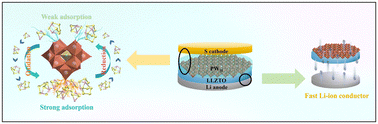
Solid-state lithium–sulfur (Li–S) batteries are deemed next-generation energy storage systems based on their high theoretical energy density and enhanced safety. However, challenges such as sluggish sulfur conversion kinetics and the polysulfide shuttle effect remain critical obstacles to their practical deployment. Herein, a novel surface-modified garnet-type Li6.4La3Zr1.4Ta0.6O12 (LLZTO) solid-state electrolyte (SSE) is proposed, utilizing a mono-lacunary Keggin-type polyoxometalate (PW11) to overcome the aforementioned limitations. The optimized PW11-LLZTO composite electrolyte exhibits a uniform surface morphology and improved interfacial stability with lithium metal. Symmetric Li/PW11-LLZTO/Li cells achieve a critical current density of 0.9 mA cm−2 and stable cycling over 800 h with low polarization. When applied in quasi-solid-state Li–S batteries, the PW11-LLZTO SSE significantly suppresses polysulfide shuttling, enhances sulfur redox kinetics, and delivers a superior reversible capacity of 619.4 mAh g−1 after 200 cycles at 1C. Density functional theory (DFT) calculations reveal that the lacunary structure alters the electron cloud density of oxygen atoms in PW11, resulting in enhanced nucleophilicity and stronger Lewis basicity, which in turn strengthens its binding interaction with Li+. Therefore, the mono-lacunary PW11 exhibits efficient Lewis acid–base interactions between the oxygen atoms of polyoxoanions and Li moieties in polysulfides, thereby facilitating the conversion kinetics of polysulfides. This work demonstrates the great potential of the lacunary strategy of polyoxometalates in designing high-performance SSEs for advanced quasi-solid-state Li–S batteries.
- This article is part of the themed collection: 2026 Inorganic Chemistry Frontiers HOT Articles
 Please wait while we load your content...


