


 PLATFORM UPDATE:


Vanadium thiocarboxylate metal–organic frameworks as efficient photocatalysts for photooxidative desulfurization

Abstract
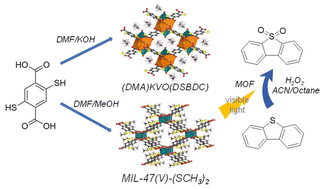
Air pollution causes the premature death of ca. 7 million people each year, with SOx gases being among the most harmful contaminants. Reducing the sulfur content in liquid fossil fuels is crucial for overcoming this health and environmental issue. Among the different available technologies, photooxidative desulfurization (PODS) stands out as one of the most promising methods, since it only requires sunlight to drive the reaction. Metal–Organic Frameworks (MOFs), with their tunable porosity and chemical diversity, have emerged as potential adsorbents and photocatalysts for the removal of sulfur-containing compounds from fuels. In this work, the reactivity of the ligand 2,5-disulfhydrylbenzene-1,4-dicarboxylic acid (H4DSBDC) with different V salts was evaluated to prepare new photocatalytically active metal–organic frameworks. Two new compounds, labeled (DMA)KVIVO(DSBDC) and MIL-47(VIII)-(SCH3)2, were successfully synthesized via solvothermal methods. X-Ray diffraction structural analysis revealed that the second solid relies exclusively on V–O bonds, whereas both V–O and V–S bonds are found in the first one. Both MOFs are stable in suspension and absorb light in the visible region, prompting their evaluation as photocatalysts for visible-light-driven reactions. For the first time, V-based metal–organic frameworks are proposed for the photooxidative desulfurization reaction. Among them, MIL-47(V)-(SCH3)2 demonstrated superior performance, achieving a desulfurization efficiency of 73%, which was maintained for at least 4 consecutive cycles.
 Please wait while we load your content...


