


 PLATFORM UPDATE:


Hierarchical assemblies of SnS microflowers and Ni3S2 nanofibers grown in situ on nickel foam for highly efficient capture of iodine vapor
 *a
and
Huiqin
Yao
*b
*a
and
Huiqin
Yao
*b
Abstract
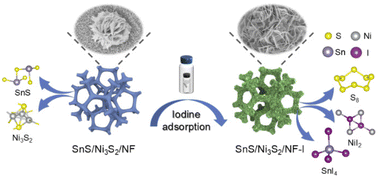
Developing cost-effective iodine sorbents is crucial for managing nuclear waste. Herein, hierarchical polymetallic sulfide assemblies of n-SnS/Ni3S2 (n is the millimolar number (0.2, 0.6 and 1.2) of the SnCl4·5H2O added) are fabricated in situ on nickel foam (NF) via a facile one-step method. The NF serves not only as a Ni source but also as a reducing agent to reduce the Sn4+ (in SnCl4) to Sn2+, leading to formation of SnS/Ni3S2/NF. The Ni0 (of Ni3S2 and NF), Sn2+ and S2− ions all work as reducing reagents to reduce I2 molecules to I− ions, while themselves are oxidized to Ni2+, Sn4+ and S8, respectively. The Ni/Sn ions bind to I− ions forming NiI2 and SnI4, achieving stable immobilization toward gaseous iodine. The optimized 0.6-SnS/Ni3S2/NF material exhibits a desirable morphology of microflowers and nanofibers well exposing sorption sites, leading to an extremely large iodine sorption capacity of 3412 mg g−1. Density functional theory (DFT) calculations exhibit negative values of iodine adsorption energies (Ead) for Sn, Ni and S sites, demonstrating rich and effective sorption sites in the polymetallic sulfide. The most elongated I–I bond (3.057 Å) bound to a Ni atom of Ni3S2 and the lowest Ead (−4.67 eV) at the Ni site indicate that it is the most effective active site for trapping iodine. The density of state (DOS) and charge density difference calculations verify the electron transfer from SnS/Ni3S2 to I2, and the interfacial effect of SnS and Ni3S2 significantly promotes the iodine capture. This study offers an important reference to develop new sorbent materials applied for controlling nuclear pollution.
 Please wait while we load your content...


