


 PLATFORM UPDATE:


Crystalline and amorphous MOFs based on an amphiphilic cyclic stereoregular p-carboxyphenylsiloxane: synthesis, structures and properties
 a
Anna V.
Vologzhanina,
a
Alexander D.
Volodin,
a
Alexander A.
Korlyukov,
a
Pavel V.
Dorovatovskii,
b
Alexey S.
Kashin,
c
Roman A.
Novikov,
c
Valery G.
Vlasenko,
d
Ashot V.
Arzumanyan
*af
a
Anna V.
Vologzhanina,
a
Alexander D.
Volodin,
a
Alexander A.
Korlyukov,
a
Pavel V.
Dorovatovskii,
b
Alexey S.
Kashin,
c
Roman A.
Novikov,
c
Valery G.
Vlasenko,
d
Ashot V.
Arzumanyan
*af
Abstract
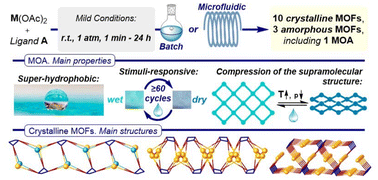
The use of the organosiloxane compound, all-cis-tetra(p-carboxyphenyl)-cyclotetrasiloxane (A), as a ligand for the construction of MOFs was studied. A has a stereoregular cyclic structure and amphiphilic nature due to 4 hydrophilic carboxyl and 4 hydrophobic trimethylsiloxy groups attached to the opposite sides of the cyclosiloxane. In spite of the well-defined configuration of A, the flexible organosiloxane skeleton allows the ligand to adopt various conformations, as illustrated by obtaining a large family of crystalline MOFs (10 examples). The structural features of these organosiloxane MOFs were studied in depth using a combination of analytical physical methods (SCXRD, PXRD, MAS SSNMR, XAS, SEM, TEM, etc.) using a Cu-containing MOF (B) as an example. Then, using acquired understanding, amorphous Cu-containing MOFs, with metal–organic aerogels (MOAs) being the brightest example, were obtained. Their structures were confirmed by comparison with the well-defined structure of MOF B and other related products. MOAs have a very low density (0.01 g mL−1) and a moderate specific surface area and are highly hydrophobic and chemically and thermally stable. For example, MOAs could be used as active and recyclable catalysts for C–N cross-coupling and aerobic oxidation. In addition, they can be evenly dispersed in a hydrophobic matrix (PDMS), allowing them to overcome challenges in obtaining homogeneous and isotropic monoliths. Due to the mobile organosiloxane skeleton of ligand A, it is possible to obtain breathing and stimulus-responsive materials, e.g., repeatedly recyclable (at least 60 times) moisture indicators. Another important advantage is the resource and energy efficiency of both A (in just two key synthetic steps under mild conditions and using inexpensive and commercially available reagents) and A-based MOF (at room temperature, 1 atm, air) synthesis. These results show the high potential of stereoregular cyclic organosiloxane ligands for designing CP and MOF structures and the creation of a new generation of stable, multifunctional, and smart hybrid materials.
 Please wait while we load your content...


