


 PLATFORM UPDATE:


l-Arginine-modified gold nanoclusters for rapid and visual quantification of bacterial infection

Abstract
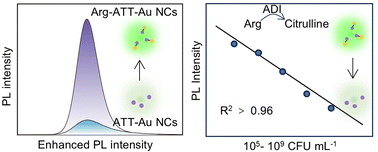
Fluorescent nanosensors based on ligand-engineered gold nanoclusters (Au NCs), guiding antibiotic therapy, offer a promising approach for rapid bacterial detection. Here, we developed dual-ligand-modified Au NCs with 6-azido-2-thiothymidine (ATT) and L-arginine (Arg), in which Arg modification enhanced the photoluminescence (PL) intensity compared to ATT-Au NCs. This enables a linear response (R2 > 0.97) to bacterial concentrations (105–109 CFU mL−1) within 30 minutes. Targeted metabolomics revealed that bacterial Arg deiminase metabolized Arg to citrulline, triggering PL quenching. Furthermore, it demonstrates the quantitative relationship between bacterial metabolic status and alterations in PL signals. The signal changes were visible under UV light and can also be quantified using a smartphone app (Light Meter). The detection limit reached 105 CFU mL−1. In vivo experiments confirmed that the probe can monitor wounds infected with Staphylococcus aureus (S. aureus), with minimal interference from biological matrices. This work highlights a portable, cost-effective strategy for point-of-care bacterial detection, addressing critical needs in clinical diagnostics.
 Please wait while we load your content...


