


 PLATFORM UPDATE:


Intense NIR absorption in air-stable octahedral complexes of tetravalent Cr, Mn, and Fe supported by a bis(carbene)-amide CNC pincer ligand

Abstract
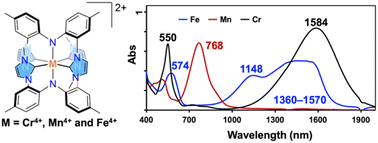
Photoactive, octahedral transition metal complexes supported by rigid, multidentate ligand scaffolds have been successfully deployed for diverse photochemical processes. Challenges remain, however, in addressing deficiencies in reaction scalability, selectivity, and media penetration. In this regard, the development of new materials with intense red or near-infrared (NIR) absorption is of great interest. Herein, we report the synthesis, structure, and spectroscopic characterization of air-stable, dicationic transition metal complexes [M(CNC)2]2+ (M = Cr, Mn, and Fe) supported by bis(carbene)-amide CNC pincer ligands. Results show intense NIR absorption (εmax ≈ 10 000 M−1 cm−1) with the metal-dependent peak maxima spanning the first and second NIR regions. Importantly, the lowest energy main NIR absorption in each complex is assigned to the ligand-to-metal charge-transfer (LMCT) transition from the amide-based non-bonding orbital to the three-centered N–M–N π-antibonding orbital. Broadly, our studies provide a blueprint for the design of intense NIR-absorbing metal complexes based on a parallel N–M–N π-bonding motif with flanking strong field carbene donors.
 Please wait while we load your content...


