


 PLATFORM UPDATE:


Built-in electric field triggered interfacial electron accumulation and structural reconstruction for boosting ampere-level-current seawater oxidation
 b
Sumin
Wang
*ab
b
Sumin
Wang
*ab
Abstract
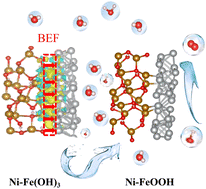
During the water splitting process for hydrogen production with metal hydroxide electrocatalysts, a self-reconstructing reaction occurring at low potential is the key to efficient operation. In this work, a Ni–Fe(OH)3 electrocatalyst is designed, in which the built-in electric field formed at the heterojunction results in electron accumulation on Ni and facilitates the reconstruction of Fe(OH)3 into active FeOOH under a lower applied potential while maintaining structural stability. Triggered by the interfacial electron accumulation and structural reconstruction, the prepared Ni–Fe(OH)3 anchored on an iron–nickel-foam substrate shows an overpotential of just 453 mV that can drive an ampere level current of 1.0 A cm−2 in 1.0 M KOH mixed seawater, with remarkable stability for over 360 h. Density functional theory calculations suggest that the in situ reconstructed Ni–FeOOH enhances the adsorption behavior of intermediates and significantly reduces the energy barrier of the oxygen evolution reaction. These results underscore the great promise of engineering a built-in electric field in transition metal hydroxide catalysts for efficient hydrogen production via seawater oxidation.
 Please wait while we load your content...


