


 PLATFORM UPDATE:


Mild synthesis and interfacial engineering for high-performance Mo-Fe2O3 photoanodes in low-bias water splitting

Abstract
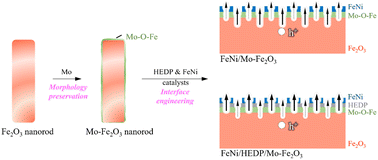
Molybdenum (Mo) doping has been recognized as an effective strategy to enhance the low-bias performance of hematite (Fe2O3) photoanodes in photoelectrochemical (PEC) water splitting. This study develops a mild hydrothermal strategy for incorporating Mo into Fe2O3 photoanodes, forming a Mo–O–Fe surface layer while avoiding the morphological degradation associated with conventional calcination. Although this modification enhances bulk charge separation and surface charge injection, the resulting Mo–O–Fe interface suppresses the functionality of directly deposited FeNi oxyhydroxide cocatalysts, yielding limited performance gains. To overcome this limitation, a hydroxyethylidene diphosphonic acid (HEDP) interlayer is introduced, which enables synergistic cooperation among the three components. It is plausible that HEDP acts as a hole-transfer mediator, shuttling holes from Mo–O–Fe surface states to the FeNi cocatalyst. The optimized FeNi/HEDP/Mo-Fe2O3 photoanode achieves a notable photocurrent density of 1.26 mA cm−2 at a low bias of 0.90 V vs. RHE and an onset potential of 0.59 V vs. RHE. The synergistic combination of mild hydrothermal doping and molecular interfacial engineering presented here provides a conceptual blueprint for the rational design of photoelectrodes, highlighting the critical need to manage interfacial charge dynamics to achieve high efficiency in the low-bias regime.
 Please wait while we load your content...


