


 PLATFORM UPDATE:


Water oxidation by Ni(ii) amido-quinoline complexes

Abstract
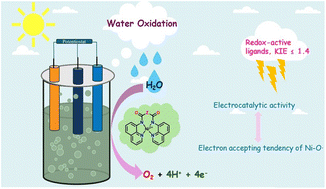
Ni(II) amido-quinoline complexes (NiL1, NiL2, NiL3) efficiently catalyze electrochemical water oxidation to O2 in a non-aqueous medium, with water as the limiting reagent. Field emission scanning electron microscopy (FE-SEM) and energy-dispersive X-ray spectroscopy (EDX) revealed no deposition of a NiOx film on the electrode, confirming the role of Ni(II) amido-quinoline complexes as true molecular electrocatalysts. Spectroelectrochemical studies revealed Ni(III) formation at the reaction onset. The redox-active amido-quinoline ligand participates in the oxidation, preventing the Ni(III) center from accessing higher oxidation states. From scan rate-dependent studies, rate constants (k0) were found to be 1.42 M−1 s−1, 1.05 M−1 s−1, and 1.99 M−1 s−1 for NiL1, NiL2, and NiL3, respectively. DFT calculations revealed that the coupling of Ni–O˙ and the adsorbed OH intermediate prefers the formation of a peroxy (NiL-OOH) intermediate over the electrochemical oxidation of Ni–O˙ with a water molecule involving a proton-coupled electron transfer step. The charge density analysis suggested that the phenyl group in the NiL3 complex reduces the electron density at the active metal centre and enhances the reactivity compared to the other complexes. Spin density analysis showed increased electron density at the O center of NiL(O˙)OH, reducing the energy barrier for NiL-OOH formation on the NiL3 complex.
 Please wait while we load your content...


