


 PLATFORM UPDATE:


Internal electric field at the Schottky junctions in an MXene–MnCdS heterostructure for complete uranium remediation
 *a
*a
Abstract
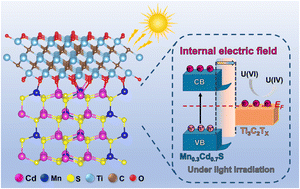
The photocatalytic reduction of soluble U(VI) offers a sustainable pathway for nuclear wastewater remediation, yet conventional systems face persistent challenges including low efficiency, limited stability, and economic problems. Herein, we address these limitations by constructing a Schottky junction between Mn0.3Cd0.7S and Ti3C2Tx MXene via a hydrothermal strategy. The optimized heterostructure achieves complete U(VI) removal within 30 min under visible light without any sacrificial agents with a maximum capacity of 831.74 mg g−1. Through combined Kelvin probe force microscopy (KPFM) and density functional theory (DFT) simulations, it is confirmed that the internal built-in electric field with band bending drives directional electron transfer from Mn0.3Cd0.7S to Ti3C2Tx, substantially enhancing charge separation. Furthermore, the MXene co-catalyst extends visible-light absorption, stabilizes photogenerated carriers, and provides abundant active sites, addressing key limitations of conventional semiconductor systems. This work establishes an efficient and stable non-precious-metal photocatalyst for uranium extraction, offering a general design principle for Schottky-based architectures targeting advanced environmental purification.
 Please wait while we load your content...


