


 PLATFORM UPDATE:


Controlling interactions between peptide-heme and G-quadruplex DNA using Fe-bound NH3 and H2O ligands
 *abcd
*abcd
Abstract
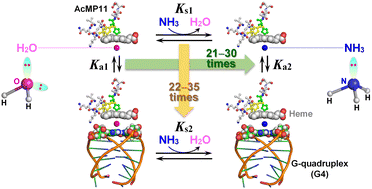
Developing ligands that improve the stability of G-quadruplex DNA (G4) is a promising anticancer strategy. We constructed a peptide-heme-NH3/G4 hybrid complex possessing a unique NH3 axial ligand between the heme and G-quartet planes. The interface between the heme and G-quartet planes is well adapted to accommodate an NH3 molecule, with a ligand substituent constant (Ks) from 98 733 ± 7141 to 18 357 ± 284 M−1 at 15–35 °C. Compared with free peptide-heme-H2O, complexation with G4 resulted in a 22–35-fold increase in Ks value. The binding constant (Ka) between peptide-heme-NH3 and G4 was determined to be between 37.6 ± 4.9 and 121.8 ± 3.0 μM−1 at 15–35 °C, 21–30-fold higher than the value observed for the peptide-heme-H2O/G4 hybrid complex. Thermodynamic analysis of experimental data showed that interactions between the heme and G-quartet planes are highly sensitive to Fe-bound NH3 and H2O ligands, which significantly enhance the thermal stability of G4 through an enthalpy-driven ligand substituent reaction and an entropy-driven complexation reaction. These findings provide novel insights and mechanistic clues for designing anticancer metal complexes targeting G4.
 Please wait while we load your content...


