


 PLATFORM UPDATE:


A broad perspective on metal complex-based optical recognition of fluoride ions: twelve years (2014–2025) of innovations and applications
 *a
and
Chittaranjan
Sinha
*c
*a
and
Chittaranjan
Sinha
*c
Abstract
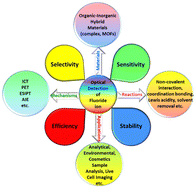
The fluoride ion (F−) is one of the most important anions because of its usefulness in maintaining oral health and bone growth and owing its existence in a variety of clinical, environmental, and food samples. The U.S. Public Health Service recommends a [F−] level of 0.7 mg L−1 in drinking water as the optimal level for the prevention of dental caries. Excessive F− exposure for a long time causes dental and skeletal fluorosis, joint stiffness, thyroid-hormone production issues, kidney problems and reproductive issues. Therefore, there is a need for analytical and practical techniques for the selective, sensitive, fast, and trace detection and quantification of fluoride ions in foods, drinks and beverages. The photophysical properties of metal complexes have been widely exploited in the design of chemosensors for F− ion detection. In recent years, many metal complex-based probes have been developed, and they are assumed to be promising for the advancement of efficient, selective, and sensitive fluoride-ion recognition. To the best of our knowledge, several reviews have been written so far, but the majority of them concentrate on organic small molecular chemosensors and some selective metal-based receptors for F− detection. Further, there are hardly any existing reports that systematically summarise metal-complex- and coordination-polymeric-framework-based receptors for F− ion recognition. This review provides an overview of the advances in the development of metal complex-based receptors, including metal–organic frameworks, for the selective recognition of fluoride over the last few years (2014–2025). This review particularly addresses the design concepts, structural features, mechanisms of action, recognition efficiencies, sensitivities, selectivities, and practical uses of metal-based receptors in fluoride sensing.
- This article is part of the themed collections: 2026 Inorganic Chemistry Frontiers HOT Articles and 2026 Inorganic Chemistry Frontiers Review-type Articles
 Please wait while we load your content...


