


 PLATFORM UPDATE:


Catalytic activation of nitrous oxide: boryl versus hydride nickel complexes

Abstract
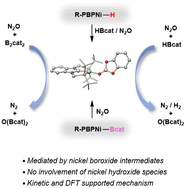
The selective reduction of nitrous oxide (N2O), a potent greenhouse gas with harmful effects on the ozone layer, remains a significant challenge in small-molecule activation. Herein, we report the efficient deoxygenation of N2O using bis(phosphino)boryl-nickel hydride (3) and bis-boryl nickel complexes (4 and 5) under mild conditions (1–2 bar N2O, 2–5 mol% catalyst loading, and 25 °C). Both catalytic systems exhibit high activity in the presence of boranes and diboranes, achieving complete N2O conversion within 30 minutes using catecholborane as the reductant. Mechanistic investigations, including stoichiometric experiments, kinetic studies, and density functional theory (DFT) calculations support the formation of nickel boroxide intermediates, (RPBP)Ni–OBR2, as key species within the catalytic cycle, while pathways involving nickel hydroxide species, (RPBP)Ni–OH, are disfavored. These results provide valuable mechanistic insights into key aspects of N2O reduction chemistry thereby enabling the rational design of transition-metal catalysts for the activation of small-molecules.
 Please wait while we load your content...


