


 PLATFORM UPDATE:


Eu(iii) dilution of Er(iii) and Yb(iii) molecular nanomagnets as a route to improving their magnetic features and creating a link with optical thermometry
 ab
Maja
Romanowska,
a
Mikolaj
Zychowicz,
ab
Sebastian
Baś,
a
Jakub J.
Zakrzewski
a
and
Szymon
Chorazy
*a
ab
Maja
Romanowska,
a
Mikolaj
Zychowicz,
ab
Sebastian
Baś,
a
Jakub J.
Zakrzewski
a
and
Szymon
Chorazy
*a
Abstract
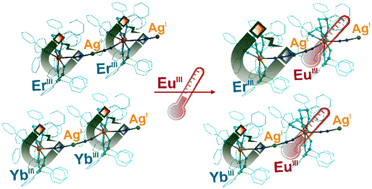
Lanthanide(III) single-molecule magnets (SMMs) are a tool for the combination of molecular nanomagnetism with luminescent thermometry, opening the pathway not only for broadened multifunctionality but also for the optical self-monitoring of temperature in SMM-based systems. Usually, this goal is realized by exploring the intrinsic properties of a single lanthanide (Ln) ion. We present an innovative strategy based on embedding magnetically anisotropic Ln(III) centers into a red-emissive coordination system based on Eu(III) complexes of a nonmagnetic ground state. This concept is presented for novel cyanido-bridged chains, {[LnIII(dppmO2)3][AgI(CN)2]}[OTf]2 (Ln = Eu, EuAg; Ln = Er, ErAg; Ln = Yb, YbAg; Ln = Er0.05Eu0.95, Er@EuAg; Ln = Yb0.04Eu0.96, Yb@EuAg; dppmO2 = bis(diphenylphosphino)methane dioxide; OTf = trifluoromethanesulfonate). The Ln(III) coordination sphere, consisting of O,O-bidentate dppmO2 ligands occupying the equatorial positions and two axially aligned cyanido bridges, generates the distinct SMM characteristics of Er(III)/Yb(III) centers. Alternatively, the strong photoluminescence of Eu(III) in EuAg exhibits pronounced thermal variation of the excitation spectrum, which is employed for ratiometric optical thermometry, revealing a relative thermal sensitivity (Sr) of up to 2.1% K−1 at 55 K and a good thermometric response below 110 K. The incorporation of Er(III)/Yb(III) centers into the Eu(III)-based framework leads to heterotrimetallic Er@EuAg and Yb@EuAg systems, which link the SMM features with luminescent thermometry. Both physical properties are enhanced upon mixing of the Ln(III) centers, as depicted by the slowdown of magnetic relaxation, especially for Er(III), due to the Eu(III)-induced weakening of the quantum tunneling of magnetization, which is accompanied by the improved thermometric response, including an increase in the maximal Sr to 3.3% K−1 and broadening of its operating range to 150 K, due to the structural distortion induced by Er(III)/Yb(III) centers.
- This article is part of the themed collection: FOCUS: Rare earth luminescent materials
 Please wait while we load your content...


