


 PLATFORM UPDATE:


A robust and flexible Cu-based metal–organic framework for gas separation and volatile organic compounds detection
 †*a
Víctor K.
Abdelkader-Fernández,
†a
Sara
Rojas,
a
Alfonso
Salinas-Castillo,
b
Manuel
Pérez-Mendoza
a
and
Antonio
Rodríguez-Diéguez
*a
†*a
Víctor K.
Abdelkader-Fernández,
†a
Sara
Rojas,
a
Alfonso
Salinas-Castillo,
b
Manuel
Pérez-Mendoza
a
and
Antonio
Rodríguez-Diéguez
*a
Abstract
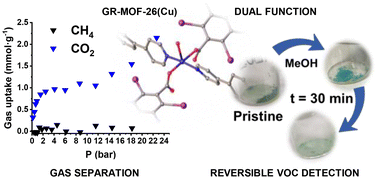
In the continuous search for new materials able to interact with CO2 and Volatile Organic Compounds (VOCs), metal–organic frameworks (MOFs) have emerged as an outstanding class in CO2 adsorption and VOCs detection. Particularly, Cu-based MOFs with coordinatively unsaturated sites (CUS) are considered one of the most appealing class of MOFs due to their ability to interact with these gases. In this work, a novel MOF named GR-MOF-26, based on copper and the combination of the 5-amino-2,4,6-triiodoisophthalic acid (H2atiip) and 4,4′-bipyridyl (bipy) ligands, is reported. This material presents Cu CUS with a square-planar pyramid geometry and exhibits permanent porosity (specific Dubinin–Radushkevich surface area of 150 m2 g−1) combined with a strong light absorption in almost the entire UV-Vis spectrum range (with a reflectance maximum at 510 nm), excellent chemical stability in different organic solvents and in a broad range of pH (from 3 to 10), and moderate selectivity for CO2 adsorption (0.98 mmol g−1 at 1 bar and 2.1 mmol g−1 at 24 bar) over CH4. Further, single-crystal X-ray diffraction studies demonstrated that GR-MOF-26 is able to reversibly change its structure and colour upon exposure to different hydrophilic VOCs, and the driving force for these changes is a combination of different parameters (such as pore content, modification of the Cu coordination sphere and/or the structural flexibility).
 Please wait while we load your content...


