


 PLATFORM UPDATE:


Tunable collinear-to-canted antiferromagnetic transition in Co(ii)-based MOFs through structural control of linker length

Abstract
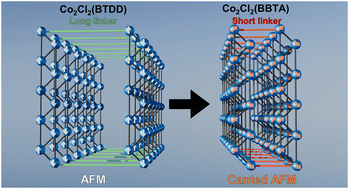
We report a comparative study of two Co(II)-based metal–organic frameworks, Co2Cl2(BBTA) and Co2Cl2(BTDD), which share an identical one-dimensional spin-chain structure but differ in their interchain distances due to variations in linker length. Through temperature-dependent magnetic susceptibility and field-dependent magnetization measurements, we demonstrate that the interchain distance plays a critical role in determining the symmetry of the magnetic ground state. Co2Cl2(BTDD), with a larger interchain separation (∼11.5 Å), exhibits collinear antiferromagnetic behavior, while Co2Cl2(BBTA), with a shorter separation (∼7 Å), shows evidence of spin canting. To quantify these differences, we employed a modified Langevin function and a dual canted antiferromagnetic chain model, enabling the extraction of key parameters, including canting angle (ϕ = 13.6°), interchain coupling constant (λ), and interchain magnetic susceptibility (χchain). These results indicate that enhanced interchain interactions in Co2Cl2(BBTA) induce a symmetry transition from collinear to canted antiferromagnetism, without altering the core spin-chain topology. Our findings demonstrate that linker-directed structural control offers a viable route to tuning the symmetry of low-dimensional magnetic phases in coordination frameworks. This study highlights a design principle for modulating magnetic ground states by engineering interchain interactions.
 Please wait while we load your content...


