


An eco-friendly self-powered X-ray detector based on a multi-layered double perovskite ferroelectric
 *ab
*ab
Abstract
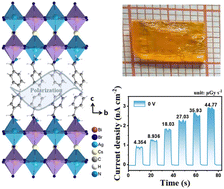
Self-powered X-ray detectors based on lead halide perovskites (LHPs) have recently gained increased traction due to their low energy consumption and easy fabrication. However, the toxicity of lead in LHPs threatens human and environmental safety, which hinders their commercialization. Herein, an eco-friendly self-powered X-ray detector has been successfully fabricated using a multilayered double perovskite ferroelectric (C6H5CH2NH3)2CsAgBiBr7 (1). The intrinsic ferroelectric spontaneous polarization property (Ps = 3.19 μC cm−2) in 1 generates an impressive polar photovoltage of 0.5 V, which provides an ideal driving force for exciton dissociation within the material, enabling X-ray detection without an external power source. The X-ray detector based on 1 shows a high sensitivity of 47.2 μC Gy−1 cm−2 and an extremely low X-ray detection limit of 716 nGy s−1 at 0 V bias. Additionally, under an applied bias of 50 V, the sensitivity increases to 1154.8 μC Gy−1 cm−2, surpassing that of most halide double perovskite detectors. This work sheds light on the great potential of multilayered double perovskite ferroelectrics for cost-effective “green” self-powered X-ray detectors.
 Please wait while we load your content...


