


 PLATFORM UPDATE:


Halogen-bond induced polar multilayer hybrid perovskites for efficient self-driven X-ray detection

Abstract
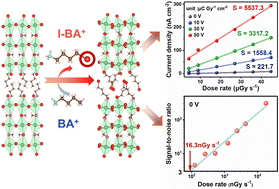
Two-dimensional (2D) hybrid perovskites possess remarkable X-ray absorption and outstanding carrier transport properties, showing great application prospects in efficient X-ray detection. However, most 2D hybrid perovskites require an external voltage to achieve X-ray detection, resulting in excessive device power dissipation and pronounced ion migration effects. Thus, it is necessary to develop novel self-driven X-ray detection materials. Here, by alloying iodine-substituted cations I-BA (I-BA = 4-iodobutylammonium) instead of n-butylamine cations into MAPbI3 (MA = methylammonium), a 2D triple-layer polar hybrid perovskite (I-BA)2(MA)2Pb3I10 (1) is acquired. Due to the introduction of iodine-substituted amines, additional non-covalent I⋯H hydrogen bonds between organic cations and I⋯I halogen bonds between cations and inorganic halides are formed, endowing 1 with a polar structure. Notably, 1 delivers a 0.15 V open-circuit photovoltage under X-ray irradiation and features self-driven X-ray detection behavior. Furthermore, 1 shows a high sensitivity of 221.7 μC Gy−1 cm−2 with a low limit of detection of 16.3 nGy s−1. The distinctive characteristics of 1 render it an excellent candidate for self-driven X-ray detection, simultaneously offering valuable guidance for the precise design of advanced X-ray detection materials.
- This article is part of the themed collection: FOCUS: Perovskite Materials and Devices
 Please wait while we load your content...


