


Fe–O-coordinated porous honeycomb carbon nanofibers: an efficient catalyst with enhanced peroxymonosulfate activation toward rapid degradation of tetracycline in water

Abstract
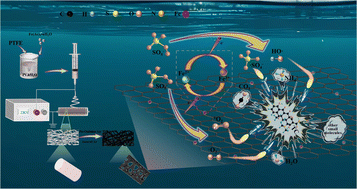
The advanced oxidation process of inorganic peroxide activation is regarded as an effective and reliable method for antibiotic removal. In this paper, we report the development of Fe–O-coordinated porous honeycomb carbon nanofibers (Fe–O-HCNF) as a high-performance catalyst for rapid degradation of tetracycline (TC) by activation of peroxymonosulfate (PMS). The effects of Fe–O-HCNF dose, PMS concentration, and initial pH were systematically investigated. The results showed that such Fe–O-HCNF achieved a high TC degradation efficiency of 84.7% within 15 minutes. The Fe–O-HCNF possessing an exceptionally high specific surface area of 691.501 m2 g−1 provides abundant adsorption and activation sites for the degradation reaction, while the introduction of iron is essential for the continuous activation of PMS. The electron paramagnetic resonance and quenching experiment results indicated that, in addition to the sulfate radical (˙SO4−) and the hydroxyl radical (˙OH), both singlet oxygen (1O2) and superoxide radicals (˙O2−) contribute to the degradation of TC. More interestingly, the Fe–O-HCNF/PMS system showed almost no interference in the real water matrices and under various initial pH conditions. Importantly, the catalyst contains only 0.48 wt% iron and exhibits exceptionally low iron leaching (<0.03 ppm), demonstrating negligible risk of secondary environmental contamination from heavy metal release.
 Please wait while we load your content...


