


 PLATFORM UPDATE:


Phosphorus chirality assignment and solution dynamics of lanthanide(iii) complexes of a monomethylphosphinate analogue of H4dota: a multinuclear NMR and DFT study

Abstract
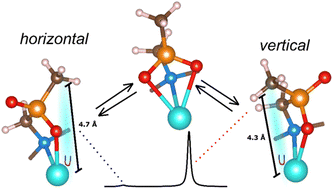
Analogues of H4dota form kinetically inert and thermodynamically stable complexes with lanthanide(III) ions and they are used in many applications in biology and medicine, mostly as imaging or therapeutic agents. Many properties of the complexes depend on their solution isomerism and dynamics which, however, have not been so thoroughly studied for ligands with phosphinate-containing pendant arms. In particular, the absolute chirality of the phosphorus atom in the diastereoisomers detected in solution by NMR has not been assigned until now, and coordinated-noncoordinated oxygen atom exchange, a process analogous to the “phosphonate rotation” in phosphonate-containing derivatives, was not studied. Here, a model H4dota analogue with one methylphosphinate group was prepared, and its LnIII complexes were studied by multinuclear (1H, 13C, 17O, 31P) NMR and DFT calculations in solution and by X-ray diffraction in the solid state. Chiral pentavalent tetrahedral phosphorus atoms are present in a number of phosphorus acid derivatives. Here, we present the first method to determine the absolute P-chirality in solution using the paramagnetic relaxation enhancement (PRE) of 13C NMR signals of the YbIII complex. The method allowed the assignment of two major diastereoisomers of the complexes as R-Λλλλλ/S-Δδδδδ (v-TSA, vertical twisted-square antiprism) and R-Λδδδδ/S-Δλλλλ (v-SA, vertical square antiprism). The assignment agrees with the solid-state structure and DFT calculations. This method enables absolute P-chirality determination in LnIII complexes of various phosphorus acid H4dota analogues in solution and can be also applied to other rigid systems. The “phosphinate rotation” process was observed by 17O/1H–1H EXSY NMR only for large LnIII ions and only in the TSA isomers. Its mechanism is analogous to that of the “phosphonate rotation” investigated recently on complexes of the mono(phosphonate monoester) H4dota analogue, but the “phosphinate rotation” is more sterically demanding in complexes of smaller lanthanide(III) ions due to the higher bulkiness of the methyl group compared with the oxygen in the ester derivatives.
 Please wait while we load your content...


