


Polymetallic titanium chalcogenide clusters comprising {En}2− ligands (E = S, Se; n = 1–3)

Abstract
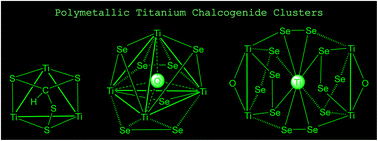
Reactive transition metal fragments can incorporate elemental chalcogens to form polynuclear chalcogen-rich clusters, which may contain either mono-, di- or polychalcogenide ligands or several such ligands in a combined form. In an effort to explore the coordination chemistry of chalcogenide ligands with titanium, we have carried out the reaction of [Cp*TiCl3] with various chalcogen sources, such as selenium, sulfur, and CS2. The in situ reaction of [Cp*TiCl3] with [LiBH4], followed by treatment with selenium powder at elevated temperature yielded unique pentametallic [{(Cp*Ti)4Ti}(μ3-η1:η2-Se2)4(μ3-η2:η2-Se2)2(μ-O)2] (1), tetrametallic [(Cp*Ti)4(μ-Se)(μ3-Se)2(μ3-η2:η2-Se2)2(μ4-O)] (2), and trimetallic [(Cp*Ti)2(Cp*TiCl)(µ-O)3(µ-1,3-Se3)] (3) titanium-chalcogenide clusters. Cluster 1 is a rare example of a dodecahedron core {TiSe8} featuring two different coordination modes of diselenide ligands; μ3-η1:η2-Se2 and μ3-η2:η2-Se2. Cluster 2 has a Ti4-tetrahedral core with a μ4-oxo group located inside the core. Interestingly, cluster 3 displays a µ-1,3-Se3 ligand in the Ti3-trimetallic framework. In contrast, when a similar reaction was performed with sulfur powder instead of selenium powder, it led to the formation of a bimetallic octasulfide complex, [(Cp*Ti)2(μ-η2:η2-S2)(µ-1,3-S3)(μ-η1:η2:η1-S3)] (4). Complex 4 shows various sulfide coordination modes: μ-η2:η2-S2, µ-1,3-S3, and μ-η1:η2:η1-S3. Additionally, a similar reaction with the CS2 ligand resulted in a homocubane-like trimetallic polysulfide cluster, [(Cp*Ti)3(μ-S)3(μ3-κ2:κ2:κ2-CHS4)] (5), where three µ-S ligands coordinate to one face of the Ti3 triangle, and one μ3-κ2:κ2:κ2-CHS4 ligand bridges the other side. All complexes have been characterized using multinuclear NMR, UV-vis, and IR spectroscopy, mass spectrometry, and single-crystal X-ray diffraction analysis. Density functional theory (DFT) calculations were also carried out to understand their bonding and electronic structures.
 Please wait while we load your content...


