


 PLATFORM UPDATE:


Unprecedented direct spatiotemporal imaging of a reversible interface propagation in a switchable cooperative Fe(iii) spin crossover material
 a
Nour el islam
Belmouri,
b
David
Ndrio,
c
Longhe
Li,
b
Hermínio P.
Diogo,
f
João
Rocha,
g
Francesc
Viñes,
c
Adrià
Gil,
h
Kamel
Boukheddaden
*b
and
Paulo N.
Martinho
*a
a
Nour el islam
Belmouri,
b
David
Ndrio,
c
Longhe
Li,
b
Hermínio P.
Diogo,
f
João
Rocha,
g
Francesc
Viñes,
c
Adrià
Gil,
h
Kamel
Boukheddaden
*b
and
Paulo N.
Martinho
*a
Abstract
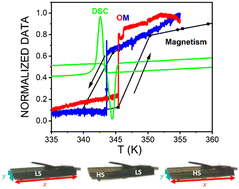
We report the unprecedented observation of reversible interface propagation in the switchable cooperative Fe(III) spin crossover compound [Fe(3-EtO-salEen)2]NO3, where 3-EtO-salEen is 3-ethoxy-N-ethyl-N-(2-aminoethyl)salicylaldiminate. This complex exhibits a spin transition from low-spin to high-spin states, triggered by temperature around 345 K. Magnetic susceptibility measurements reveal an abrupt transition with a thermal hysteresis of 5 K. Differential scanning calorimetry confirms both endothermic (Ton = 344.50 K and Tmax = 345.61 K,  and
and  ) and exothermic (Ton = 344.40 K, Tmax = 345.49 K,
  and
and  ) peaks corresponding to the spin transition temperatures. Cryogenic optical microscopy reveals rapid interface propagation, with velocities (vHS→LS ≃ 1672 μm s−1 and vLS→HS ≃ 850 μm s−1) significantly higher than those observed in traditional Fe(II)-based spin crossover materials. The high-speed propagation is attributed to the combined effect of the reduced volume change and lower elastic energy barriers associated with the transition in Fe(III) systems and the high values of the transition temperatures. Hirshfeld surface analysis reveals that the cooperative nature of the transition is influenced by non-conventional hydrogen bonding and π–π interactions. This study represents the first report of reversible interface propagation in Fe(III) complexes, providing valuable insights into the fundamental mechanisms that govern spin crossover transitions in these systems.
 Please wait while we load your content...


