


 PLATFORM UPDATE:


Different roles of similar aromatic rings in half-sandwich lanthanide single-ion magnets unravelled by ab initio electronic structure calculations
 *a
*a
Abstract
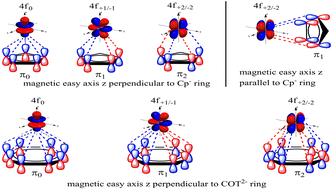
Herein, a systematic ab initio study was carried out on a group of half-sandwich lanthanide (Ln) single-ion magnets (SIM) composed of one LnIII ion, one aromatic ring and several non-aromatic ligands. Our theoretical predictions are generally consistent with experimental results. Although not perfect from an electrostatic viewpoint, the cyclopentadienyl (Cp−) ring can become the crucial ligand in DyIII-SIM due to its capability to generate a certain metal–ligand orbital interaction, i.e., covalency, favouring SIM performance. However this case is subject to the condition that other non-aromatic ligands are weak enough. If this condition was not fulfilled, the Cp− ring will not be the crucial ligand in DyIII-SIM. Then the orbital interaction between the Cp− ring and DyIII becomes detrimental to the SIM performance. The neutral benzene (Bz) ring behaves in a way similar to Cp− but requires the non-aromatic ligands to be even weaker. From the viewpoints of both electrostatics and covalency, the cyclooctatetraenyl (COT2−) ring is not suitable for DyIII-SIM and thus it never becomes the crucial ligand there. The crucial ligating atom in those DyIII-SIMs involving COT2− are actually phenolic O atoms with a formal charge of −1. For ErIII-based half-sandwich SIMs, neither the Cp− nor the Bz ring is a good choice. However, the half-sandwich ErIII-SIMs, involving COT2− rings, show a SIM performance inferior to that of the corresponding half-sandwich DyIII-SIMs. This is due to two points. Firstly, the orbital interaction pattern between COT2− and ErIII is less favourable to SIM performance. Secondly, there exist strong ligating O atoms, not from COT2−, in the corresponding DyIII-SIMs. Starting from 1, we designed a new structure 1a wherein a phenoxy group gives its formally negatively charged O atom as the trans ligating atom to DyIII. Compared to 1, 1a is predicted to have significantly longer τQTM (around 14 000 second) and higher Ueff (around 2000 Kelvin). 1a holds the possibility of a TB of 30 Kelvin, which is more than twice of that of 1.
 Please wait while we load your content...


