


 PLATFORM UPDATE:


Spin state modulation and chiral hierarchical assembly via amine-driven single-crystal-to-single-crystal transformation
 *a
Jinkui
Tang
*ab
*a
Jinkui
Tang
*ab
Abstract
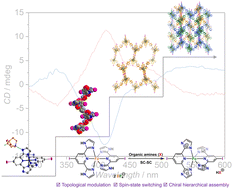
We report a mononuclear Fe(II) synthon, Fe-BF4, with four acidic NH sites and two terminal iodo-groups, for achieving achiral or chiral supramolecular hydrogen- and/or halogen-bond frameworks through amine-driven single-crystal-to-single-crystal (SC–SC) transformation. Et3N-driven SC–SC transformation enables the formation of both a hydrogen- and halogen-bonded 2D architecture and a halogen-bonded 1D chain, accompanied by a magnetic transition from spin-crossover behavior to the low-spin state. When the optically pure amine, R/S-quinuclidinol, is introduced, the crystal undergoes a transformation from a centrosymmetric to a chiral structure. This successfully generates 1D hydrogen-bonded helical chains with M/P-helicity, which are further orthogonally linked via intermolecular C–I⋯N halogen bonds, forming three individual yet identical networks. Remarkably, these three networks adopt an alternating stacking arrangement, resulting in a three-fold interpenetrated supramolecular architecture. This hierarchical assembly illustrates a controlled transition from an achiral to a chiral configuration. Therefore, the amine-triggered SC–SC transformation in Fe-BF4 provides an effective strategy for simultaneously controlling the topological architectures and spin states of advanced supramolecular frameworks.
 Please wait while we load your content...


