


 PLATFORM UPDATE:


Computational design of helical artificial metallopeptides: from sequence to activity in Pd-peptide systems

Abstract
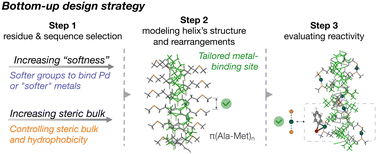
Artificial metallopeptides hold immense potential to combine enzymatic activity with the versatility of organometallic catalysts. However, computational de novo design is largely limited to theozyme models that may neglect second-sphere atomic structure, overlook hydrogen-bonding networks, and ignore metal-induced conformational selection. We overcome these limitations for the case of helical metallopeptides and metal-containing helical motifs by proposing a DFT-based bottom-up methodology applied to the design of Pd-binding (Met-X)n sequences (X = Ala, Val, Ile). Line group symmetry theory is employed to accelerate the calculations by leveraging helical monoperiodicity for computational efficiency. The methodology (a) reproduces the geometric parameters of α-poly-Ala with near-experimental accuracy; (b) to the best of our knowledge, provides the first evidence that the α → π-transition may manifest as a first-order phase transition; (c) identifies (Met-Ala)n π-helices as preferred matrices for canonical Pd(II) Suzuki coupling intermediates. In contrast, Pd incorporation in the α-helical matrix poses significant challenges, as shown by relaxed potential energy scans. From the periodic π-helix, we extract a cluster containing over 250 atoms and model it in aqueous solution at the ωB97X-V/def2-TZVP-gCP//B97-3c level to obtain reliable energetics for the free energy profile of the key oxidative addition step. The profile featured a low activation barrier and exergonic product formation, with reaction energy falling within the optimal window and barriers lower than those reported for bis-phosphine Pd(0) complexes. This methodology offers an efficient strategy for the de novo design of helical peptides and motifs and environmentally benign bioinorganic catalysts, from sequence to the reactivity of the metal center.
 Please wait while we load your content...


