


 PLATFORM UPDATE:


Amino-imidazolin-2-imine Cu(i) complexes: ligand screening and tuning of photophysical properties
 †a
Oliver
Lange,
†b
Lars E.
Burmeister,
b
Michael
Karnahl,
*b
Stefanie
Tschierlei,
*b
Matthias
Tamm
*a
and
René
Frank
*a
†a
Oliver
Lange,
†b
Lars E.
Burmeister,
b
Michael
Karnahl,
*b
Stefanie
Tschierlei,
*b
Matthias
Tamm
*a
and
René
Frank
*a
Abstract
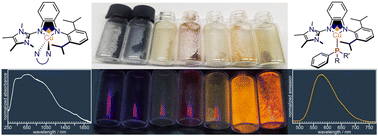
Amino-imidazolin-2-imines (HAmIm) are introduced as a new class of strong monoanionic N,N′-chelating ligands for Cu(I) complexes. The reaction of HAmIm with CuCl, followed by deprotonation to give AmIm−, affords the dinuclear precursor [Cu2(μ-AmIm)2], which serves as a versatile platform for the synthesis of structurally diverse mononuclear Cu(I) complexes. Coordination with diimine ligands (phenanthroline or neocuproine) yields distorted tetrahedral [Cu(AmIm)(diimine)] species featuring a broad UV/vis absorption. In contrast, reaction with monodentate phosphines (L1–L5) affords trigonal planar complexes [Cu(AmIm)(L)], which are non-emissive in solution, but exhibit pronounced emission in the solid state. All ten new complexes were structurally characterised by single-crystal X-ray diffraction, enabling a direct correlation between coordination geometry and photophysical properties. Photophysical studies and TDDFT calculations reveal fluorescence in the nanosecond-range originating from ligand-to-ligand and mixed metal–ligand-to-ligand charge-transfer transitions (LL′CT, mMLL′CT). The emission properties correlate with the nature of the phosphine ligand. In particular, complexes containing chalcogen-bridged phosphines (L4 and L5) display the highest intensities and lifetimes of up to ≈29.2 and ≈13.9 ns, respectively. Temperature-dependent time-resolved measurements confirm prompt fluorescence and exclude thermally activated delayed fluorescence (TADF), underscoring the intrinsic nature of the emission. These results highlight the modular potential of HAmIm ligands to access structurally diverse and photoactive Cu(I) complexes with tunable solid-state emission.
 Please wait while we load your content...


