


 PLATFORM UPDATE:


Localizing tetrahedral aluminum in nitrate-bearing gibbsite to constrain defect-impurity coupling
 *a
Micah P.
Prange,
a
Xin
Zhang,
a
J. David
Bazak,
a
Khashayar
Ghandi,
b
Gregory K.
Schenter
a
and
Carolyn I.
Pearce
ac
*a
Micah P.
Prange,
a
Xin
Zhang,
a
J. David
Bazak,
a
Khashayar
Ghandi,
b
Gregory K.
Schenter
a
and
Carolyn I.
Pearce
ac
Abstract
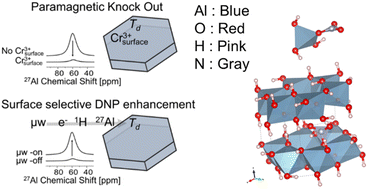
The enhanced radiolytic stability of gibbsite (α-Al(OH)3) containing trace nitrate (NO3−) is a phenomenon in nuclear waste management, but its structural origins remain unresolved. Motivated by the detection of minority tetrahedral aluminum (Td) defects in synthetic gibbsite, we hypothesized that these sites may participate in NO3− retention or mediate H2 suppression. To evaluate this, we combined orthogonal techniques comprised of spatially selective solid-state 27Al MAS NMR, comparative spectroscopy, and density functional theory (DFT) modeling. Paramagnetic editing and dynamic nuclear polarization (DNP) MAS NMR confirm that Td defects are confined to the particle interior. DFT calculations reveal no energetic stabilization of NO3− near Td sites. Comparative NMR analysis shows that Td is also present in chloride-bearing gibbsite, which exhibits high radiolytic hydrogen yields. These three independent disqualifications rule out Td as a structural contributor to nitrate-mediated suppression and narrow the scope of defect-driven explanations. The findings redirect mechanistic attention away from coordination defects and toward redox-active impurity pathways, providing a refined foundation for understanding radiation tolerance in Al(OH)3.
 Please wait while we load your content...


