


 PLATFORM UPDATE:


Quenching quantum tunnelling of the magnetization utilizing 4d–4f exchange interactions in butterfly-shaped {Ru III2Ln III2} (Ln = Gd, Tb, Dy, Ho, and Er) single-molecule magnets

Abstract
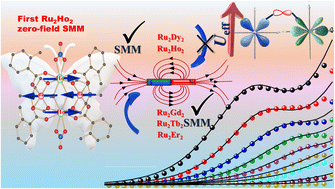
The performance of Single-Molecule Magnets (SMMs) can be enhanced by reducing quantum tunneling of magnetization (QTM), which can be achieved with the aid of strong magnetic exchange interactions and strong magnetic anisotropy. When 4d ions are mixed with 4f ions, the strong spin–orbit coupling and moderate ligand-field strength of 4d elements complement the highly anisotropic 4f ions, and the combined effect decreases the transverse anisotropy and stabilizes the magnetic easy axis, both of which are essential for lowering QTM. Despite their synthetic challenges, the unique electronic properties of 4d–4f systems make them promising candidates for designing advanced single-molecule magnets. Here, we report the synthesis, magnetic, and theoretical studies of five tetranuclear “butterfly-shaped” complexes of formulae [RuIII2LnIII2(OMe)2(o-tol)4(mdea)2(NO3)2] (Ln = Gd (1-Gd), Tb (2-Tb), Dy (3-Dy), Ho (4-Ho), mdeaH2 = N-methyldiethanolamine) and [RuIII2ErIII2(OMe)2(o-tol)6(mdea)2]·2MeOH (5-Er). Complexes 2-Tb, 4-Ho, and 5-Er are the first reported examples of Ru-4f complexes using these LnIII ions. DC magnetic susceptibility studies revealed an antiferromagnetic exchange interaction between the LnIII and RuIII metal ions in all complexes. Among the complexes reported, 3-Dy and 4-Ho show out-of-phase susceptibility signals in the absence of an external magnetic field, while the remaining complexes exhibit field-induced slow relaxation of magnetization. These observations were attributed to the presence of an ideal crystal field combined with the strong exchange interaction exerted between the RuIII and LnIII ions in the complexes. Importantly, the 4-Ho is the first non-dysprosium Ru–Ln polynuclear complex to show zero-field SMM behavior. Detailed ab initio CASSCF + RASSI-SO + SINGLE_ANISO + POLY_ANISO and Density Functional Theory (DFT) calculations reveal that the magnitude of exchange interaction increases in the following order: 1-Gd (−1.3 cm−1) < 2-Tb (−1.8 cm−1) < 3-Dy (−2.7 cm−1) < 4-Ho (−2.8 cm−1) < 5-Er (−4.0 cm−1). The larger single-ion anisotropy of the DyIII ions in 3-Dy leads to the largest barrier of 101.8 cm−1 (146 K), which increases further to 111 cm−1 (158.7 K) when considering the exchange-coupled model, with the strong Ru⋯Ln exchange further quenching QTM effects. These results highlight the importance of strong magnetic exchange between 4d–4f (RuIII⋯LnIII) ions in enhancing the SMM behavior of 4d–4f complexes.
 Please wait while we load your content...


