


 PLATFORM UPDATE:


Acid–base interactions in luminescent silver(i) and gold(i) complexes with phosphine–phosphinate/phosphinite ligands

Abstract
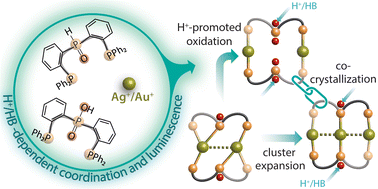
Hybrid phosphines with anionic hard donor functions can be used to create an adaptable ligand environment for soft late transition metals. Herein, we show that the change of coordination of a diphosphine–phosphinic acid (P3OOH) in response to acid–base interactions or hydrogen bonding results in structural transformations of a disilver complex [Ag2(P3OO)2] (1) to give solvated and protonated derivatives [Ag2(P3OOH)2]2+ (2) and [Ag3(P3OO)3H]+ (3), accompanied by the alteration of the quantum yield of the solid-state photoluminescence from 0.06 up to 0.69. The related diphosphine–phosphide oxide complexes [M2(P3O)2] (M = Ag, Au) are oxidized to phosphinate compounds 2 and non-luminescent [Au2(P3OO)2H]+ (5) in the presence of triflic acid. Alternatively, [Au2(P3O)2] readily accommodates an additional gold(I) ion to yield a trinuclear cluster [Au3(P3O)2]+ (6), which is brightly sky-blue phosphorescent in the crystalline state (Φem = 0.76). The phosphide oxide group −P![[double bond, length as m-dash]](https://www.rsc.org/images/entities/char_e001.gif) O in 6 is stable towards oxidation under acidic conditions in solution but undergoes protonation that results in two orders of magnitude (>170-fold) increase of the emission intensity. Complex 6 acts as a guest in the crystalline matrix of 5 due to their structural similarity and affords solid solutions with bright luminescence at a doping content of 1–2%.
O in 6 is stable towards oxidation under acidic conditions in solution but undergoes protonation that results in two orders of magnitude (>170-fold) increase of the emission intensity. Complex 6 acts as a guest in the crystalline matrix of 5 due to their structural similarity and affords solid solutions with bright luminescence at a doping content of 1–2%.
 Please wait while we load your content...


