


 PLATFORM UPDATE:


Sustainable solar seawater splitting over a BaTaO2N photoanode enabled by chloride recirculation
 *a
*a
Abstract
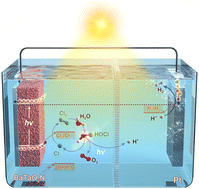
This study demonstrates that BaTaO2N photoanodes grown on Ta substrates via bottom-up fabrication exhibit highly efficient and stable photoelectrochemical (PEC) seawater splitting under simulated sunlight. Enhanced H2 evolution is achieved, particularly in acidic to neutral pH conditions, where the oxygen evolution reaction (OER) typically proceeds at a slower rate. This improvement is attributed to the predominant chlorine evolution reaction (CER), facilitated by a kinetically favorable two-electron transfer pathway. The high crystallinity and cuboidal morphology of BaTaO2N, combined with uniform Co(OH)x catalyst loading, result in over 80% photocurrent retention and a faradaic efficiency close to 100% after continuous seawater splitting for 24 h. This outstanding efficiency is attributed to the distinct band structure of BaTaO2N, which hinders the formation of hydroxyl radicals and selectively promotes oxidation through CER and OER. Remarkably, CER outperforms OER at pH levels below 7.5, while OER becomes more dominant at higher pH levels. Moreover, the free chlorine produced during CER decomposes gradually back to O2 and Cl− through photolytic and chemical processes, which ensures continuous regeneration of Cl− in the bulk electrolyte. This self-sustaining cycle facilitates prolonged photoreaction within a fixed seawater volume, which eliminates the need for continuous seawater flow configurations. By overcoming a crucial obstacle in the scalable generation of solar H2 from seawater, these results provide a promising route for sustainable and selective PEC seawater splitting.
 Please wait while we load your content...


