


 PLATFORM UPDATE:


A crystalline supramolecular polymer constructed by the controlled self-assembly of clamparene and its application in photothermal conversion

Abstract
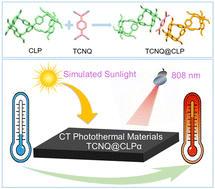
Organic charge-transfer (CT) cocrystals are a class of novel crystalline materials formed by the self-assembly of electron-rich donors (D) and electron-deficient acceptors (A) at specific stoichiometric ratios. They possess the advantages of structural tunability and facile preparation, and have been widely applied in diverse fields owing to their distinctive photothermal effects. However, critical bottlenecks in targeted structural design still need to be addressed. Organic photothermal materials exhibit prominent advantages and versatile applications, yet conventional organic photothermal materials are hampered by drawbacks such as complicated synthesis procedures and limited programmable substrates. Consequently, developing simple and universal preparation protocols has become an urgent priority in this research field. In this work, we report a solid-state supramolecular polymer with robust charge-transfer characteristics, which is constructed from the electron-rich molecule clamparene (CLP) and the electron-deficient molecule 7,7,8,8-tetracyanoquinodimethane (TCNQ). Under simulated sunlight irradiation at a power density of 0.35 W cm−2, the temperature of this material rapidly rises to approximately 110 °C. After five consecutive heating–cooling cycles, its photothermal conversion efficiency (PCE) remains stable without any significant attenuation or structural degradation. Moreover, under 808 nm laser irradiation, the TCNQ@CLPα composite demonstrates an exceptionally high photothermal conversion (PTC) efficiency of 90.03%. This study thus provides a novel and promising strategy for the rational design of high-performance photothermal conversion materials.
- This article is part of the themed collections: Polymer Chemistry Emerging Investigators and Polymer Chemistry Emerging Investigators Series
 Please wait while we load your content...


