


 PLATFORM UPDATE:


Thermoplastic solid-state polymer electrolytes based on linear B–A–B tri-block copolymers
 *bc
*bc
Abstract
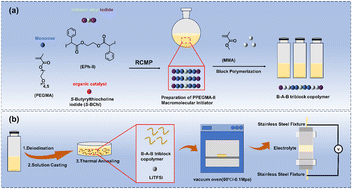
Conventional liquid electrolytes in lithium-ion batteries suffer from safety concerns such as leakage, flammability, and lithium dendrite growth. To address these issues, microphase-separable linear B–A–B tri-block copolymers (PMMAn-b-PPEGMAm-b-PMMAn) were designed and synthesized via organocatalyzed living radical polymerization, and subsequently, solid polymer electrolytes (SPEs) were prepared by incorporating lithium bis(trifluoromethanesulfonyl)imide (LiTFSI) salt, where PMMA and PPEGMA are poly(methyl methacrylate) and poly(poly(ethylene glycol) methyl ether methacrylate), respectively. The metal-free polymerization strategy eliminates potential catalyst residues that may deteriorate electrochemical performance. The well-defined tri-block architecture enables microphase separation between the rigid PMMA and flexible PPEGMA segments, forming mechanically reinforced nanodomains and continuous Li+-conducting pathways, respectively. Atomic force microscopy (AFM) and scanning electron microscopy (SEM) analyses confirmed the formation of nanoscale phase-separated structures, while differential scanning calorimetry (DSC) and X-ray diffraction (XRD) results demonstrated the fully amorphous nature of the LiTFSI salt-containing solid polymer electrolyte (SPE) membranes. The optimized composition, PMMA30-b-PPEGMA19-b-PMMA30, exhibited a tensile strength of 38 MPa and an ionic conductivity of 6.08 × 10⁻⁶ S cm−1 at 70 °C. The temperature-dependent conductivity followed a non-Arrhenius behavior consistent with segmental-motion-assisted ion transport. Linear sweep voltammetry further demonstrated a wide electrochemical stability window up to approximately 5.4 V vs. Li/Li+. This well-defined linear B–A–B tri-block topological architecture enabled feasible microphase separation between PMMA and PPEGMA segments and provided an elegant combination of mechanical robustness and efficient Li+ conduction when an SPE is formed by the incorporation of LiTFSI salt into the block copolymer matrix.
 Please wait while we load your content...


