


 PLATFORM UPDATE:


Metal-free synthesis of terpene-derived polyester-block-polycarbonates and post-polymerization modification via thiol–ene click chemistry

Abstract
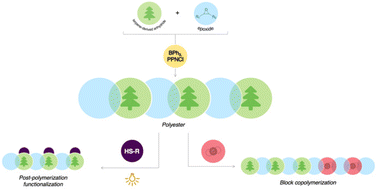
Sustainable polymers are a large research focus due to depleting resources and increasing environmental pollution. Therefore, renewable feedstocks are being pursued as an alternative to fossil-derivatives for producing polymers. Here, we have prepared a series of polyester and polyester-block-polycarbonate copolymers via metal-free ring-opening copolymerizations (ROCOPs) of various terpene-derived cyclic anhydrides, epoxides [cyclohexene oxide (CHO) and propylene oxide (PO)], and carbon dioxide (CO2) under neat (solvent-free) conditions. Cyclic anhydrides were prepared via microwave-assisted Diels Alder reactions between terpenes and maleic anhydride (up to 90% yield) with no purification required. The ROCOP catalyst system consisted of triphenylborane (BPh3) with bis(triphenylphosphine)iminium chloride (PPNCl) and resulted in polymers with moderate molecular weights (Mn ≤ 13 kDa), and dispersities (1.05 ≤ Đ ≤ 1.75). Thermal analysis resulted in a single glass transition temperature (1.5 °C ≤ Tg ≤ 101 °C) indicating amorphous materials. 13C{1H} NMR spectroscopy revealed high stereoregularity with respect to substituent methyl groups and di-ester units and 2D DOSY NMR spectroscopy confirmed a single polymer chain was formed by sequential copolymerizations. Residual olefinic groups in these polymers were subjected to post-polymermization functionalization via photoinitiated thiol–ene (3-mercaptopropionic acid and butyl 3-mercaptopropionate) ‘click’ chemistry with 2,2-dimethoxy-2-phenylacetophenone as the photoinitiator. High degrees of functionalization (>99%), increased molecular weights (Mn ≤ 49 kDa), and differing solubilities and hydrophilicities were observed. Thermal analysis further demonstrated the ability to tune polymer properties; modified polymers yielded high decomposition temperatures (≈300 °C) and dramatically different Tg than the non-functionalized precursors, and one modified polymer displayed a melting temperature (Tm) indicating thermoplastic behaviour.
- This article is part of the themed collection: Polymer Chemistry Open Access Spotlight 2026
 Please wait while we load your content...


