


 PLATFORM UPDATE:


Elucidating the molecular design principles of N-alkylated nylons for LCST-type phase separation through a systematic polymer library
 *ab
and
Kazuki
Sada
*ab
*ab
and
Kazuki
Sada
*ab
Abstract
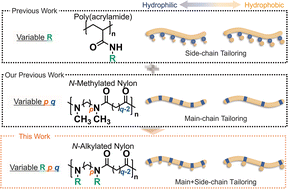
Hydrophilic polymers showing LCST-type phase separation are useful functional polymer materials. In this study, we expanded the N-alkylated nylon library by varying the main-chain carbon numbers (p and q) and the N-alkyl side chains (R = ethyl, n-propyl, and isopropyl), and further designed branched and copolymer structures to systematically evaluate their effects on water solubility and LCST-type phase separation. We found that structural variations in the N-alkyl side chains, including linear and branched isomers with identical hydrophilic/hydrophobic balance, significantly influence water solubility, demonstrating that structural features permitting hydration of the amide groups are essential for molecular design of LCST-type phase separation. Moreover, backbone rigidity was identified as another important factor governing LCST-type phase separation. These findings provide a deeper understanding of the molecular design required for LCST-type phase separation and highlight N-alkylated nylons as a unique class of hydrophilic polymers exhibiting LCST-type phase separation.
- This article is part of the themed collection: Polymer Chemistry Open Access Spotlight 2026
 Please wait while we load your content...


