


 PLATFORM UPDATE:


Stereochemically purified trans-dihydroxy-substituted cage silsesquioxane-based bisurea supramolecular polymer materials enable metastable-to-thermodynamic phase evolution and enhanced modulus

Abstract
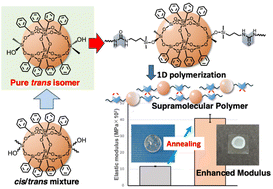
The dynamic nature of interactions in supramolecular polymers imparts distinctive properties compared to those of conventional covalent polymers. A deeper understanding of the thermal behavior associated with phase transitions in supramolecular polymers is essential for the development of advanced materials. Recently, we synthesized a DDSQ-based bisurea derivative (mix-1) from an octaphenyl-substituted cage silsesquioxane bearing two hydroxymethylsilane groups (DDSQ-2SiOH) as a mixture of cis/trans isomers. This derivative (mix-1) underwent one-dimensional supramolecular polymerization followed by crosslinking in solution, yielding a transparent, freestanding film that exhibited a metastable phase transition upon heating. In the present study, the trans isomer of DDSQ-2SiOH was isolated from the cis/trans mixture by recrystallization and subsequently used to synthesize a trans-DDSQ-based bisurea derivative (trans-1). The supramolecular polymer material properties of trans-1 were investigated. The as-cast trans-1 film exhibited a distinct exothermic peak within a narrower temperature range and demonstrated a significantly higher elastic modulus than the as-cast mix-1 film. Upon annealing, the elastic modulus of the as-cast trans-1 film increased fourfold and exceeded that of the annealed mix-1 film. These findings indicate that the supramolecular polymer material not only demonstrates superior bulk mechanical properties relative to typical polymeric materials but also exhibits an effective metastable-to-thermodynamic phase transition.
 Please wait while we load your content...


