


 PLATFORM UPDATE:


Selectively controlled ring-opening copolymerization to chemically recyclable thermoplastic elastomers
 *a
and
Jian-Bo
Zhu
*a
*a
and
Jian-Bo
Zhu
*a
Abstract
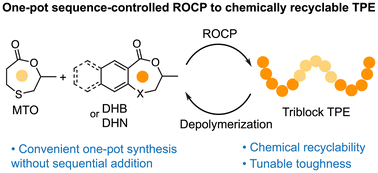
The development of closed-loop recyclable thermoplastic elastomers (TPEs) represents a promising solution to address serious plastic pollution. However, the traditional synthetic and chemical recycling pathways of triblock TPEs face significant challenges due to their intrinsic complex multicomponent nature. Herein, we created a one-pot sequence-controlled copolymerization platform towards chemically recyclable TPEs. The distinct polymerization reactivity of aliphatic caprolactone-based monomer MTO (2-methyl-1,4-oxathiepan-7-one) and benzo-fused or naphthalene-fused caprolactone-based monomer DHB or DHN (2,3-dihydro-5H-1,4-benzodioxepin or 2,3-dihydro-5H-naphthodioxepin-5-one) allowed construction of ABA triblock TPE products in which the low-Tg PMTO segment served as the soft midblock and the high-Tm P(DHB) block or high-Tg P(DHN) block as hard end segments. Remarkably, these resulting TPE products showcased tunable material properties once their compositions were altered. TPE4 with FDHN = 0.21 demonstrated outstanding tensile strength, ductility, impressive toughness (UT = 133 ± 14 MJ m−3), and high elastic recovery (>90%). More importantly, these synthesized TPE materials could depolymerize back into their monomers in the presence of Sn(Oct)2 at 160–200 °C, thereby establishing efficient closed-loop recycling.
 Please wait while we load your content...


