


 PLATFORM UPDATE:


Photobase generators for amino acid N-carboxyanhydride ring-opening photopolymerization: rapid access to degradable polypeptide-based networks

Abstract
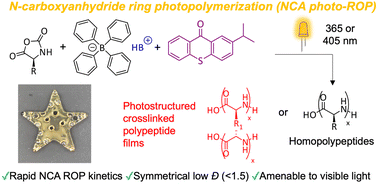
Conventional resin systems for 3D object fabrication rely predominantly on non-degradable (meth)acrylate networks, despite global concerns about microplastic persistence. Polypeptide-based networks offer an attractive alternative due to their inherent biocompatibility and degradability, yet efficient methods to photochemically access such materials remain severely underdeveloped. In this contribution, photobase generators (PBGs) are introduced as efficient initiating systems for photo-induced N-carboxyanhydride (NCA) ring-opening polymerization (ROP), enabling rapid (<10 min) and spatiotemporally controlled polypeptide synthesis using ultraviolet (365 nm) and visible (405 nm) light irradiation. Incorporation of disulfide-containing difunctional NCA monomers enables photostructuring of crosslinked polymer networks, which can be readily degraded on demand using chemical reductants. This strategy represents the first demonstration of light-triggered NCA ROP by PBGs to provide direct access to photocurable, degradable polypeptide networks. The combination of rapid photopolymerization and reductive degradability shown here may truly expand the utility of NCA ROP systems as next-generation resins for manufacture of 3D structures with on-demand degradability.
- This article is part of the themed collection: Polymer Chemistry Open Access Spotlight 2026
 Please wait while we load your content...


