


 PLATFORM UPDATE:


Synthesis and structure–property relationships of lipoic acid-based conductive elastomers

Abstract
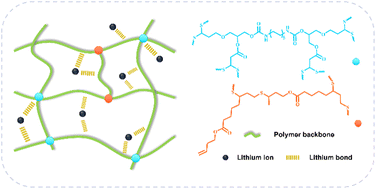
It is generally recognized that the functionalization of lipoic acid has a pronounced effect on the compatibility of lithium salts, such as lithium bis((trifluoromethyl)sulfonyl)azanide (LiTFSI). Here, we further demonstrate that the compatibility between lithium salts and lipoic acid-based matrices is also constrained by the available coordination space for lithium ions within the polymer network. Based on this concept, a vinyl-functionalized lipoic acid monomer with moderate lithium salt compatibility and a four-arm flexible crosslinker were synthesized, enabling pronounced structural and property responses to variations in crosslinker content. When the molar ratio of the crosslinker was increased from 3% to 6%, the reduced coordination space led to a decrease in ionic conductivity and optical transmittance to 48.3% and 46.7% of their initial values, respectively. These results identify coordination space as a critical yet previously overlooked structural parameter governing lithium salt compatibility, providing new insights into the regulation of polymer network structure and structure–property relationships in ionic conductive elastomers.
 Please wait while we load your content...


