


 PLATFORM UPDATE:


A computational framework for tuning intra- and intermolecular ductility in polyurethanes
 *b
and
Linjiang
Chen
*ab
*b
and
Linjiang
Chen
*ab
Abstract
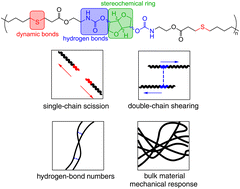
The development of sustainably sourced polymers with robust mechanical properties is an important aspect of the challenge to mitigate the impact of plastic waste on the environment. However, with a wide range of potential bio-derivable building blocks and chemicals with which to construct polymers, predicting their thermomechanical properties is challenging. To address this challenge, here we established an integrated computational framework to relate chemical design to mechanics in isohexide-based polyurethanes (PUs). We combined and varied three structural motifs: (i) dynamic-bond moieties in the backbone, (ii) hydrogen-bonding moieties that mediate interchain cohesion, and (iii) stereochemical ring configurations. Density functional theory (DFT) with the “External Force is Explicitly Included” (EFEI) formalism quantified how different dynamic bonds control single-chain scission forces, while semiempirical EFEI calculations and classical molecular dynamics (MD) revealed how the number and arrangement of hydrogen-bond sites govern double-chain shear forces. Reactive MD with ReaxFF was used to probe uniaxial tensile deformation of amorphous PU bulk systems. Sulfur-containing dynamic-bond moieties markedly reduced single-chain scission forces, consistent with their use in self-healing and reprocessable PUs, whereas nitrogen-containing motifs combined with highly multidentate hydrogen-bonding groups maximized both intrachain strength and interchain cohesion. A representative design (NO5M) achieved a substantially higher peak stress than a disulfide-rich analogue (SS4I) under tensile loading. This multiscale framework yields chemically interpretable design rules for high-performance, recyclable PUs and illustrates the synergistic use of EFEI and MD simulations in polymer mechanochemistry.
- This article is part of the themed collection: Polymer Chemistry Open Access Spotlight 2026
 Please wait while we load your content...


