


 PLATFORM UPDATE:


Tunable silicone elastomers through PDMS ring network design and post-curing chemistry

Abstract
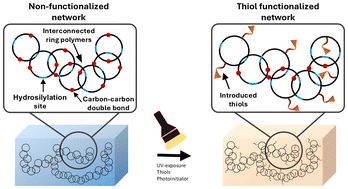
Tailoring elastomer properties after network formation remains a significant challenge. In this work, we introduce post-cure functionalizable polydimethylsiloxane (PDMS) elastomers based on networks of interlocked (concatenated) ring polymers. The ring networks were achieved via a platinum-catalyzed hydrosilylation reaction between a synthesized divinyl-terminated prepolymer containing internal C![[double bond, length as m-dash]](https://www.rsc.org/images/entities/char_e001.gif) C bonds and dihydride-terminated PDMS. Ring formation arises from a combination of intra- and intermolecular reactions during network formation, producing interlocked ring architectures without conventional cross-linkers. NMR spectroscopy shows the absence of reactive end groups, and SEC of the sol fraction reveals low-molecular-weight species consistent with ring formation, while mechanical testing confirms extremely soft, highly extensible elastomers (Young's modulus < 0.4 MPa, strains at break ∼ 1000%) with high gel fractions (>90%). Post-cure functionalization was achieved via a swelling/permeation approach followed by UV-initiated thiol–ene click chemistry. Solid-state 13C-NMR confirmed thiol incorporation with conversion efficiencies of ∼22% for 3-chloro-1-propanethiol, ∼25% for 2-chlorothiophenol, and ∼7% for 2-aminoethanethiol. Mechanical testing revealed that the chloropropane-functional thiol reduced the storage modulus. In contrast, the aminoethane-functional thiol introduced hydrogen-bonding interactions that reinforced the network, as indicated by an increase in tensile strength. Functionalization also enhanced the dielectric permittivity, reaching values of up to 8.3, with both the dielectric and mechanical responses being dependent on the thiol structure and the degree of incorporation. These results establish ring-based PDMS networks as a tunable platform for next-generation soft materials, with potential as dielectric elastomers, soft robotics, and flexible electronics.
C bonds and dihydride-terminated PDMS. Ring formation arises from a combination of intra- and intermolecular reactions during network formation, producing interlocked ring architectures without conventional cross-linkers. NMR spectroscopy shows the absence of reactive end groups, and SEC of the sol fraction reveals low-molecular-weight species consistent with ring formation, while mechanical testing confirms extremely soft, highly extensible elastomers (Young's modulus < 0.4 MPa, strains at break ∼ 1000%) with high gel fractions (>90%). Post-cure functionalization was achieved via a swelling/permeation approach followed by UV-initiated thiol–ene click chemistry. Solid-state 13C-NMR confirmed thiol incorporation with conversion efficiencies of ∼22% for 3-chloro-1-propanethiol, ∼25% for 2-chlorothiophenol, and ∼7% for 2-aminoethanethiol. Mechanical testing revealed that the chloropropane-functional thiol reduced the storage modulus. In contrast, the aminoethane-functional thiol introduced hydrogen-bonding interactions that reinforced the network, as indicated by an increase in tensile strength. Functionalization also enhanced the dielectric permittivity, reaching values of up to 8.3, with both the dielectric and mechanical responses being dependent on the thiol structure and the degree of incorporation. These results establish ring-based PDMS networks as a tunable platform for next-generation soft materials, with potential as dielectric elastomers, soft robotics, and flexible electronics.
 Please wait while we load your content...


