


 PLATFORM UPDATE:


Uncovering a radical-mediated mechanism in the Kumada catalyst transfer polymerization of glycolated polythiophenes
 b
and
Christine
Luscombe
*a
b
and
Christine
Luscombe
*a
Abstract
Glycolated polythiophenes are of great interest for their use as organic mixed ionic-electronic conductors (OMIECs). In this study, we elucidate the polymerization mechanism for the synthesis of poly(3-((2-(2-methoxyethoxy)ethoxy)methyl)thiophene) (P3MEEMT) using Kumada catalyst transfer polymerization (KCTP). While the use of i-PrMgCl·LiCl (turbo-Grignard) for monomer activation enabled rapid polymerization within 10 min at room temperature, this resulted in lower than expected number-average molecular weight (Mn). We propose that the polymerization proceeds via a radical-mediated pathway, a mechanism not observed for poly(3-hexylthiophene) (P3HT). This was demonstrated by the complete inhibition of the reaction by the radical scavenger TEMPO and the detection of radical species by EPR spectroscopy using DMPO as a spin trap. By introducing MgCl2 after Grignard metathesis, a controlled polymerization was afforded with Mn proportional to the catalyst loading. This work establishes that KCTP of glycolated thiophenes proceeds via a radical-assisted pathway and provides a strategy to control the polymer molecular weight. These findings establish a new principle for controlling polymerizations, where the monomer's physical aggregation state is the key factor in enabling a productive, radical-mediated pathway.
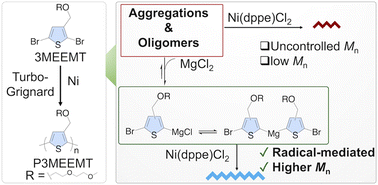
- This article is part of the themed collections: Polymer Chemistry Open Access Spotlight 2026 and Polymer Chemistry 15th Anniversary Collection
 Please wait while we load your content...


