


 PLATFORM UPDATE:


Digital light processing 3D printable smart silicone-based elastomeric composites based on a synergistic dual-compatibilization strategy

Abstract
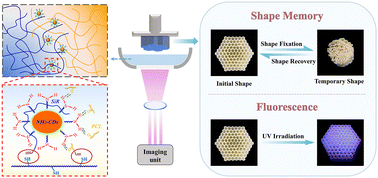
Liquid silicone rubber (SiR) exhibits significant application value in medical devices, flexible electronics, and soft robotics due to its excellent biocompatibility, tunable mechanical properties, and chemical stability. The additive manufacturing of SiR via 3D printing technology enables the customized fabrication of complex structures, particularly in multidisciplinary fields that require personalized designs, such as biomedical implants, bioinspired flexible sensors, and dynamically responsive soft robots. Despite the high precision achievable through stereolithography (SLA) or digital light processing (DLP) photocuring techniques, the low modulus of SiR remains a challenge for high-precision 3D printing. Inspired by the concept of polymer composites, blending SiR with mechanically robust polycaprolactone (PCL, a biocompatible polymer) provides an effective strategy to address these limitations, but still faces the challenge caused by the poor compatibility between SiR and PCL. In this study, a synergistic dual-compatibilization strategy was designed, and amphiphilic compatibilizers (amino-functionalized carbon quantum dots, NH2-CDs) and modified polycaprolactone (PCL-DA) were introduced to enhance interfacial compatibility between the two phases. The introduced NH2-CDs, functioning as a nanoscale compatibilizer, effectively suppressed phase separation through interfacial Pickering stabilization, which resulted in a dramatic reduction of the dispersed SiR domain size from 25.94 ± 9.29 μm to 2.33 ± 0.55 μm, accompanied by the formation of a distinct interfacial layer (∼860 nm). The resulting SiR/PCL-DA/NH2-CD composite fulfills the requirements for photocurable 3D printing, achieving high precision, multi-morphological adaptability, and considerable mechanical performance. It exhibits considerable mechanical performance with a tensile strength of 440.7 kPa and an elongation at break of 367%. Additionally, the incorporation of semi-crystalline PCL and NH2-CDs endows the system with shape memory functionality (triggered at −5 °C and 60 °C) and fluorescence properties. This work presents a feasible approach for developing biocompatible, photocurable silicone elastomer-based composites via DLP 3D printing, offering broad prospects for advanced applications in smart materials and biomedical engineering.
 Please wait while we load your content...


