


 PLATFORM UPDATE:


Chiral proline-derived Zn(ii) complexes as catalysts for ring-opening polymerization and ring-opening copolymerization reactions

Abstract
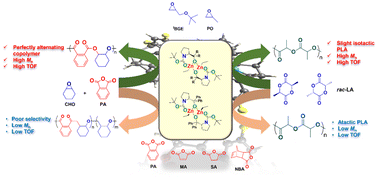
A series of novel chiral dimeric Zn(II) complexes, comprising both (S)- and (R)-isomers, were synthesized utilizing N-Boc protected proline-derived ligand scaffolds. The reaction of diethylzinc (ZnEt2) with equimolar amounts of pro-ligands (L1H–L4H) in anhydrous toluene afforded the corresponding Zn(II) complexes (1–4) in high yields. The solid-state structures of complexes 1 and 3 were elucidated via single-crystal X-ray diffraction, revealing a distorted tetrahedral coordination geometry around the Zn(II) center. However, spectroscopic analysis indicated the presence of monomeric Zn(II) species in solution. All synthesized complexes were evaluated for their catalytic performance in the ring-opening polymerization (ROP) of racemic lactide (rac-LA) and ring-opening copolymerization (ROCOP) of phthalic anhydride (PA) with cyclohexene oxide (CHO), as well as other epoxide–anhydride combinations. All the Zn(II) complexes demonstrated activity in the ROP of rac-LA, yielding polylactide (PLA) with stereoregularity ranging from atactic (Pr = 0.51) to slightly isotactic-enriched (Pm = 0.58), influenced by the ligand architecture and chirality. The ROP is proposed to proceed via a ligand-initiated coordination–insertion mechanism. All the Zn(II) complexes (1–4) were catalytically active in the presence of a cocatalyst, with bis(triphenylphosphine)iminium chloride (PPNCl) delivering optimal performance. The ROCOP of CHO with PA yielded alternating copolyesters with moderate to high number-average molecular weights (Mn ≈ 7200 g mol−1) and moderate dispersity (Đ ≈ 1.33). (R)-4 catalyzed the formation of an atactic polyester, whereas (S)-2 enabled the synthesis of a perfectly alternating poly(PA-alt-CHO) with enhanced isotacticity. Kinetic studies revealed that complex (S)-1 exhibited a fourfold higher polymerization rate compared to (R)-4. DFT energy calculations revealed a favourable mechanistic pathway wherein the dimeric zinc species dissociates into monomeric active intermediates, a crucial step in facilitating the ROCOP.
 Please wait while we load your content...


