


 PLATFORM UPDATE:


Cyclization polymerization of diyne and dimethyl sulfoxide towards poly(m-terphenyl)s
 *a
Jia
Wang
*b
*a
Jia
Wang
*b
Abstract
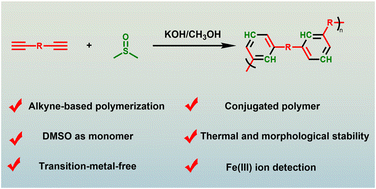
Conjugated polyarylenes with well-defined structures and functional properties are highly desirable for advanced materials, but their synthesis often requires harsh conditions or expensive catalysts. In this work, an efficient, transition-metal-free cyclization polymerization of aromatic diynes using dimethyl sulfoxide (DMSO) as both a solvent and a key reactant was developed. This polymerization is applicable to a wide range of aromatic diynes, producing a series of poly(m-terphenyl)s with high weight-average molecular weights (Mw up to 22 700) in moderate to high yields (up to 94%) at 130 °C under nitrogen in the presence of KOH/CH3OH. The poly(m-terphenyl)s exhibited excellent thermal stability (Td up to 367.7 °C) and morphological stability (Tm up to 252.5 °C). Moreover, the tetraphenylethylene (TPE)-containing poly(m-terphenyl)s display aggregation-enhanced emission (AEE) properties, and its aggregates could serve as a fluorescent probe for Fe3+ detection, showing high selectivity and sensitivity (limit of detection = 8.21 × 10⁻⁷ M) with a large Stern–Volmer quenching constant (49 970 M−1). Therefore, this work not only expands the toolkit of alkyne-based polymerization but also provides a cost-effective strategy to convert low-cost industrial raw materials (DMSO) into functional conjugated polymers, holding great promise for chemical sensing applications.
 Please wait while we load your content...


