


 PLATFORM UPDATE:


Superionic conduction in solid polymer electrolytes – decoupling ion transport from segmental relaxation
 a
and
Thomas H.
Epps, III
*abc
a
and
Thomas H.
Epps, III
*abc
Abstract
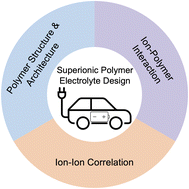
Solvent-free, solid polymer electrolytes (SPEs) are promising candidates for next-generation, electrochemical energy storage systems due to their potential to enhance safety and performance, enable flexible device architectures, and streamline manufacturing processes. Conventional SPEs suffer from limited ionic conductivity due to the strong coupling between ion transport and (generally slow) polymer segmental relaxation. The realization of superionic conduction in SPEs, in which ions move faster than the structural relaxation of the polymers, requires a shift in design principles to promote this type of decoupled ion motion. In this perspective, we discuss how polymer architecture, ion–ion correlations, and ion–polymer interactions can unlock superionic behavior. We highlight several key design features, such as crystallinity, bulky side groups, high molecular weight, and percolating ionic aggregation, with a focus on creating low-barrier transport pathways in various polymer systems. We also demonstrate opportunities to combine polymer chemistry and data science through high-throughput and automated screening approaches to reveal how phase behavior, ion dynamics, and ionic interactions govern transport, thereby potentially enabling data-driven discovery of superionic polymer electrolyte materials.
- This article is part of the themed collection: Polymer Chemistry Open Access Spotlight 2026
 Please wait while we load your content...


