


 PLATFORM UPDATE:


Recent advances in the synthesis and application of task-specific porous poly(ionic liquid)s for heterogeneous catalysis

Abstract
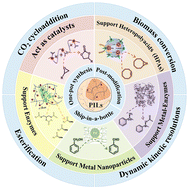
Poly(ionic liquid)s (PILs), with their inherent ionic functional moieties and tunable macromolecular architectures, exhibit distinct advantages in heterogeneous catalysis, including high charge density, customizable porous frameworks, and abundant active sites. However, to date, no comprehensive review has systematically summarized task-specific PILs for heterogeneous catalytic applications. This review provides a critical overview of three representative synthetic strategies for PIL-based catalysts: (1) one-pot ionomerization to produce functional poly(ionic liquid)s with selected comonomers; (2) post-polymerization functionalization to achieve precise introduction of functional groups for spatial control of active sites; (3) confined-space encapsulation (“ship-in-a-bottle” strategy) to realize restricted growth of active species and enhance catalytic stability. These well-defined PILs can directly serve as task-specific heterogeneous catalysts for esterification, CO2 cycloaddition, and biomass conversion through synergistic ionic interactions, or be integrated with heteropolyacids, noble metal nanoparticles, metal oxides, and enzymes to construct synergistic/tandem catalytic systems. The review further highlights paramount challenges in achieving precise structural control of PILs, improving recycling stability, and developing multi-component synergistic catalysis platforms, thereby offering novel perspectives for the rational design of advanced heterogeneous catalysts.
 Please wait while we load your content...


