


 PLATFORM UPDATE:


Preparation, characterization, and magnetic properties of poly(3-methoxythiophene)-Fe3O4 conducting nanocomposite
 *ab
Satoru
Tsukada
*a
*ab
Satoru
Tsukada
*a
Abstract
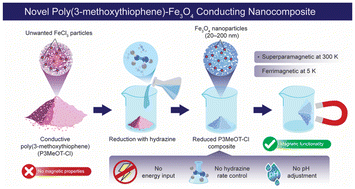
Conducting polymers complexed with magnetic nanoparticles have attracted considerable attention in recent years due to their potential applications in magnetic materials for biomedical and clinical uses. In this study, a unique and facile method is described for the preparation of a novel composite, which consists of poly(3-methoxythiophene) combined with Fe3O4 nanoparticles. Notably, hydrazine reduction of the resulting complex formed between poly(3-methoxythiophene) and the iron chlorides produced the desired composite under an ambient atmosphere without any additional energy input. This was also achieved without controlling the amount and addition rate of hydrazine, or adjusting the system pH. Elemental analysis, X-ray powder diffractometry, X-ray photoelectron spectroscopy, and Fourier-transform infrared spectroscopy indicated that the approximate empirical formula of the composite was (C5H5OS)2(C5H4OS)9.3·0.25Cl·5.5Fe3O4·9.4H2O. Additionally, transmission electron microscopy and scanning electron microscopy observations demonstrated the presence of almost spherical Fe3O4 particles with diameters ranging from ∼20 to 200 nm in the composite. Furthermore, superconducting quantum interference device measurements demonstrated its superparamagnetic behavior with a saturation magnetization of 11.9 emu g−1 at 300 K. Moreover, ferrimagnetic behavior was detected, with a saturation magnetization of 20.2 emu g−1 and a coercivity of 500 Oe at 5 K. Overall, this work represents a novel and mild approach for the synthesis of magnetic materials using polythiophenes, one of the most prominent and commercially successful conducting polymers, which are known to exhibit good chemical and electrochemical stabilities under air, and in the presence of moisture, both in the doped and undoped states.
- This article is part of the themed collection: Polymer Chemistry Open Access Spotlight 2026
 Please wait while we load your content...


