


 PLATFORM UPDATE:


Degradable vinyl copolymers featuring backbone dithiocarbonates by radical copolymerization of a cyclic xanthate

Abstract
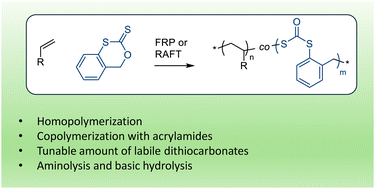
Radical thiocarbonyl addition-ring-opening (TARO) copolymerization has emerged as a promising method to install weak linkages into vinyl-based polymers. However, the portfolio of available monomers is limited to thionolactones and cyclic thiocarbamates. Herein, a cyclic xanthate featuring an additional in-ring sulfur atom, 4H-1,3-benzoxathiin-2-thione (BOT), was prepared by reacting 2-mercaptobenzyl alcohol with thiophosgene, avoiding the commonplace thionation reaction. An AIBN-initiated radical polymerization of BOT resulted in 37% conversion and approx. 75 mol% ring-opened dithiocarbonate repeat units alongside ring-retained dithioorthoester repeat units. A series of N,N-dimethylacrylamide (DMA)–BOT copolymers was prepared with copolymer BOT contents ranging from 2.5 mol% to 16 mol% with quantitative ring-opening. BOT was found to be less reactive than DMA with estimated reactivity ratios of rDMA = 2.73 and rBOT = 0.04, which led to BOT incorporation throughout the high-yielding copolymerization in the absence of vinyl homopolymerization reported for the use of other thionolactone monomers. The BOT repeat units were easily cleaved through aminolysis and basic hydrolysis. Uniquely, the dithiocarbonate repeat units featured two cleavable C–S bonds, meaning that the degradant was not retained as a fragment end group. Cyclic xanthates are therefore useful for the preparation of easily degradable acrylamide copolymers.
- This article is part of the themed collections: Polymer Chemistry Open Access Spotlight 2026 and Pioneering Investigators 2025
 Please wait while we load your content...


