


 PLATFORM UPDATE:


Highly stable PEDOT coatings realized via a simple yet robust charge regulation strategy
 *ac
*ac
Abstract
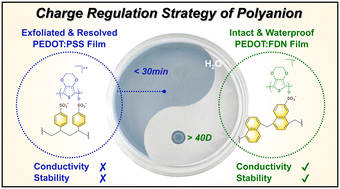
Poly(3,4-ethylenedioxythiophene):poly(styrenesulfonate) (PEDOT:PSS) has been extensively employed as a flexible conductive coating in diverse application fields. However, the existence of numerous weak electrostatic interactions within the PEDOT:PSS matrix presents a significant challenge to the material's stability. Herein, we demonstrate that a slight reduction in the charge density of the outer-shell polyanion can effectively inhibit the penetration of degradation-inducing molecules, preserving the structural integrity and electrostatic stability of the entire matrix. Specifically, reducing the polyanion's charge density lowers the electrostatic repulsion encountered by oxidant ions during the oxidative polymerization process, thereby accelerating the reaction kinetics and facilitating the formation of an enlarged PEDOT:polyanion matrix. The increased matrix size leads to a significant decrease in its specific surface area, thus effectively reducing the number of surface charges available for interaction with degradation-inducing agents such as 1,8-diiodooctane, chloroform, and water. Simultaneously, enhanced coulombic trapping of polarons was observed, providing a complementary mechanism that contributes to improved overall stability. Impressively, the PEDOT film demonstrates remarkable resistance to water immersion, maintaining structural integrity for over 40 days without evidence of exfoliation, swelling, or dissolution. This study offers a meaningful reference for improving the stability of PEDOT coatings via polyanion engineering.
 Please wait while we load your content...


