


 PLATFORM UPDATE:

Formulation and evaluation of isosorbide dinitrate-loaded flash-release dispersible sublingual wafers

Abstract
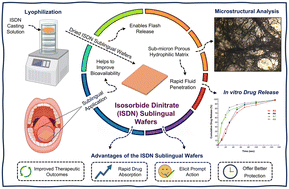
This study aimed to design flash-release dispersible sublingual wafers of isosorbide dinitrate (ISDN) by lyophilisation (LYO) by applying the principles of Quality by Design (QbD). Sublingual wafers and films were developed by LYO and solvent casting (SC) techniques, respectively, via a 23 factorial design using hydroxypropyl methylcellulose E15 as polymer and propylene glycol as plasticizer. Scanning electron microscopy (SEM) revealed the porous nature of these wafers with sub-micron-sized pores, while atomic force microscopy (AFM) indicated their homogeneous surface with minimal irregularities (<3.5 nm). Fourier transform infrared (FTIR) spectroscopy proved the chemical integrity of ISDN in the polymer matrix. Differential scanning calorimetry (DSC) and X-ray diffraction (XRD) conclusively indicated amorphisation of ISDN in the hydrophilic polymeric matrix in the wafers. Structural analysis was performed with a surface area and pore size analyser using liquid nitrogen as adsorbent and revealed that the wafers displayed significantly higher (p < 0.05) specific surface area (13.428 m2 g−1) and pore volume (∼0.013 cc g−1) values compared to the films. Density analysis by the gravimetric method further indicated that the density of the films (1.44 ± 0.23 g cm−3) was found to be significantly higher (p < 0.04) than that of the wafers (0.633 ± 0.012 g cm−3), confirming the denser microstructure of films and the porous nature of wafers. Wafers developed by optimising the LYO process displayed significantly shorter (p < 0.0001) disintegration time (3.1 ± 0.5 s) and time taken for 80% drug release (46 ± 0.2 s), compared to films produced by the SC technique. ISDN sublingual wafers exhibited a transmucosal flux that was comparable (p > 0.05) to that from the drug solution, indicating the potential to elicit a quick onset. The sublingual wafers that were found to rapidly disperse and quickly dissolve are likely to evade first-pass metabolism and elicit a prompt onset. The studies indicate that the developed sublingual wafers will be a promising platform for prophylactic management of cardiac emergencies.
 Please wait while we load your content...


